
The orange wrench light on a Ford F-150 is the powertrain malfunction indicator. It means the engine or transmission computer has found a fault, most often in the electronic throttle, the transmission, or the charging system. Many trucks also drop into a reduced-power “limp mode” when it comes on. It is not a routine maintenance reminder, so you should get the trouble codes read soon.
This guide is part of our Ford F-150 Owner’s Guide, with every key spec and common fix in one place.
Wrench Light vs Check Engine Light
| Light | What it watches | What it usually means |
|---|---|---|
| Orange wrench | Powertrain: throttle, transmission, 4WD, charging voltage | A fault that can limit power or shifting; truck may be in limp mode |
| Check engine (engine outline) | Emissions and engine sensors | An engine or emissions fault; can be minor (loose gas cap) or serious |
| Wrench + check engine together | Both systems | A fault that affects both, such as a throttle body or voltage problem |
Ford does not use the wrench as an oil change reminder on the F-150. Oil change prompts appear as a message on the dash (“Oil Change Required” or “Change Engine Oil Soon”).
Common Causes of the F-150 Wrench Light
1. Electronic throttle body problems
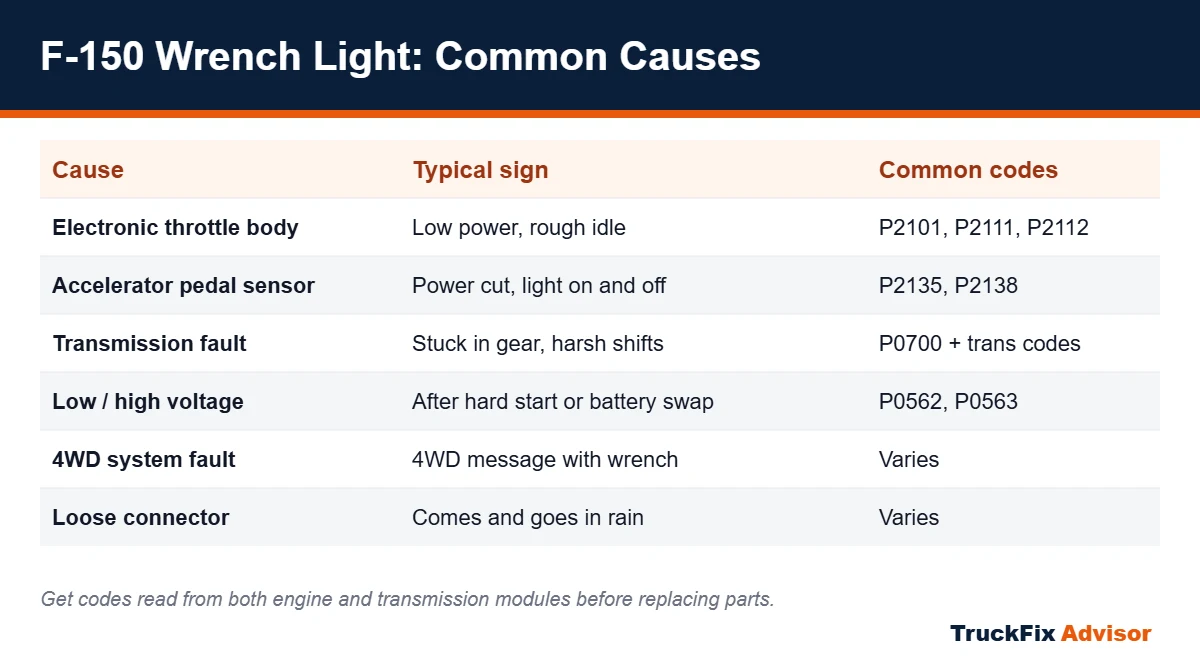
The throttle body is controlled by the computer, not a cable. If the throttle position sensors disagree or the motor sticks, the truck sets a code and limits power. Carbon buildup and a failing throttle body are among the most common reasons for the wrench light. Typical codes include P2101, P2111, P2112, P2135 and P2138.
2. Accelerator pedal sensor fault
The gas pedal has its own position sensors. A worn pedal sensor or a bad connector can make the computer think the pedal and throttle do not match, which turns on the wrench and cuts power.
3. Transmission faults
On many F-150s the wrench appears together with a “Transmission Fault” or “Transmission Overheating” message. Causes include a failing shift solenoid, speed sensor, torque converter clutch problem, low transmission fluid or overheated fluid (common when towing). The truck may hold one gear to protect the transmission.
4. Low or high battery voltage
A weak battery, a failing alternator or corroded battery cables can drop system voltage. The engine and transmission modules then log voltage codes (such as P0562 or P0563) and may switch on the wrench. If the light came on after a hard start or a battery change, start here.
5. 4WD system faults
On 4×4 trucks, a problem with the transfer case or its control module can also trigger the wrench light, often together with a 4WD message.
6. Loose or corroded connectors
Water and dirt can get into the connectors at the throttle body, pedal sensor or transmission. A poor connection gives the same symptoms as a failed part, so check the plugs before replacing anything.
What to Do When the Wrench Light Comes On
- Notice how the truck drives. Is power reduced? Is it stuck in one gear? Is the transmission temperature high?
- Pull over safely. Turn the truck off, wait a minute and restart. If the fault was temporary, the truck may return to normal power, but the code stays stored.
- Check the dash messages. A “Transmission Fault,” “Transmission Overheating” or 4WD message tells you which system to look at.
- Read the codes. Have codes read from both the engine (PCM) and transmission (TCM) modules. Many auto parts stores read codes for free, and a dealer can check for software updates.
- Do not tow or drive long distances until the cause is found, especially if the transmission is involved.
Is It Safe to Drive With the Wrench Light On?
You can usually drive a short distance carefully, for example to get home or to a repair shop. Avoid highway merging and towing if the truck has reduced power, because you may not get full acceleration. Stop driving and call for a tow if the light comes on with an overheating warning, low oil pressure warning, loud noises from the transmission, or if the truck shakes or loses power badly. Driving on a transmission fault can turn a cheap sensor repair into a costly rebuild.
How Mechanics Diagnose the Wrench Light
- Scan both engine and transmission modules for stored and pending codes.
- Test battery voltage with the engine off (about 12.6 volts) and running (about 13.5 to 14.7 volts).
- Inspect the throttle body for carbon and check its connector.
- Check transmission fluid level and condition, and look at fluid temperature data.
- Look for Ford technical service bulletins and software updates for the exact truck.
Frequently Asked Questions
What does the wrench light mean on a Ford F-150?
It is the powertrain malfunction indicator. It means the engine or transmission computer has detected a fault, often in the electronic throttle, the transmission or the charging system. The truck may limit power to protect itself, so get the codes read soon.
Will the wrench light go away by itself?
Sometimes the light turns off after a restart if the fault was temporary, such as a short voltage drop. The trouble code still stays stored in memory, so it is worth having it read. If the light keeps coming back, the problem is still there.
Is the wrench light an oil change reminder?
No. On the F-150, oil change reminders show as text messages in the instrument cluster. The orange wrench means a powertrain fault, not a service interval.
Can low transmission fluid cause the wrench light?
Yes. Low or overheated transmission fluid can cause shifting problems and transmission fault codes, which can turn on the wrench light and put the truck in limp mode.
Can a bad battery turn on the wrench light?
Yes. Low system voltage from a weak battery, a failing alternator or corroded cables can set voltage codes in the engine and transmission modules and turn on the wrench light. Test the battery and charging system first, because it is the cheapest fix.
How much does it cost to fix the F-150 wrench light?
It depends on the cause. Reading codes is often free at parts stores. Cleaning or replacing a throttle body, fixing a connector or replacing a sensor is usually a moderate repair, while internal transmission problems cost much more. Finding the exact code first is the best way to avoid paying for parts you do not need.
Related: See our F-150 battery size guide and F-150 oil capacity chart.
More F-150 guides: F-150 tailgate won’t open · How to reset the oil life · Complete F-150 owner’s guide
This guide is general information. Warning light behavior can vary by model year and software. If you are unsure, have the truck checked by a qualified technician or Ford dealer.