
This is the Ford F-150 owner’s guide we wish came in the glovebox: every key spec and the most common fixes in one place, with links to our detailed guides. Use the quick reference table to find a number fast, then jump to the full guide for year-by-year charts, step-by-step instructions and FAQs. It covers mainly 2015–2026 trucks, with notes for older F-150s where the specs differ.
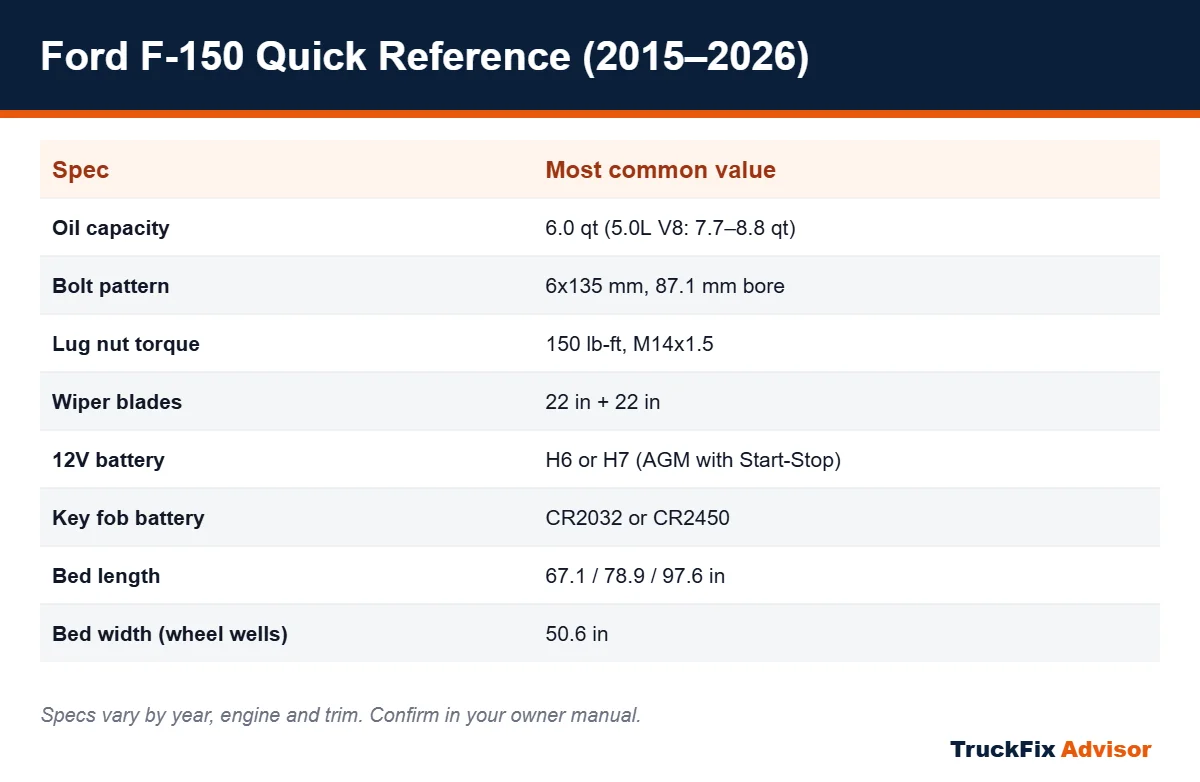
F-150 Quick Reference (2015–2026)
| Spec | Most common value | Full guide |
|---|---|---|
| Oil capacity | 6.0 qt on most engines; 7.7–8.8 qt on the 5.0L V8 | Oil capacity chart |
| Oil type | 5W-30 (EcoBoost, hybrid, 2021+ 5.0L); 5W-20 (3.3L, 2015–2020 5.0L) | Oil capacity chart |
| Bolt pattern | 6×135 mm, 87.1 mm center bore | Bolt pattern by year |
| Lug nut torque | 150 lb-ft, M14x1.5 studs | Bolt pattern by year |
| Wiper blades | 22″ driver + 22″ passenger (2009–2026) | Wiper size chart |
| 12V battery | H6 (48) or H7 (94R); AGM with Auto Start-Stop | Battery size guide |
| Key fob battery | CR2032 (integrated key) or CR2450 (most push-button fobs) | Key fob battery guide |
| Bed length | 5.5 ft = 67.1 in, 6.5 ft = 78.9 in, 8 ft = 97.6 in | Bed dimensions |
| Bed width between wheel wells | 50.6 in | Bed dimensions |
Specs change by model year, engine and trim. Always confirm the exact value for your truck in the owner’s manual or on the labels in the door jamb and under the hood.
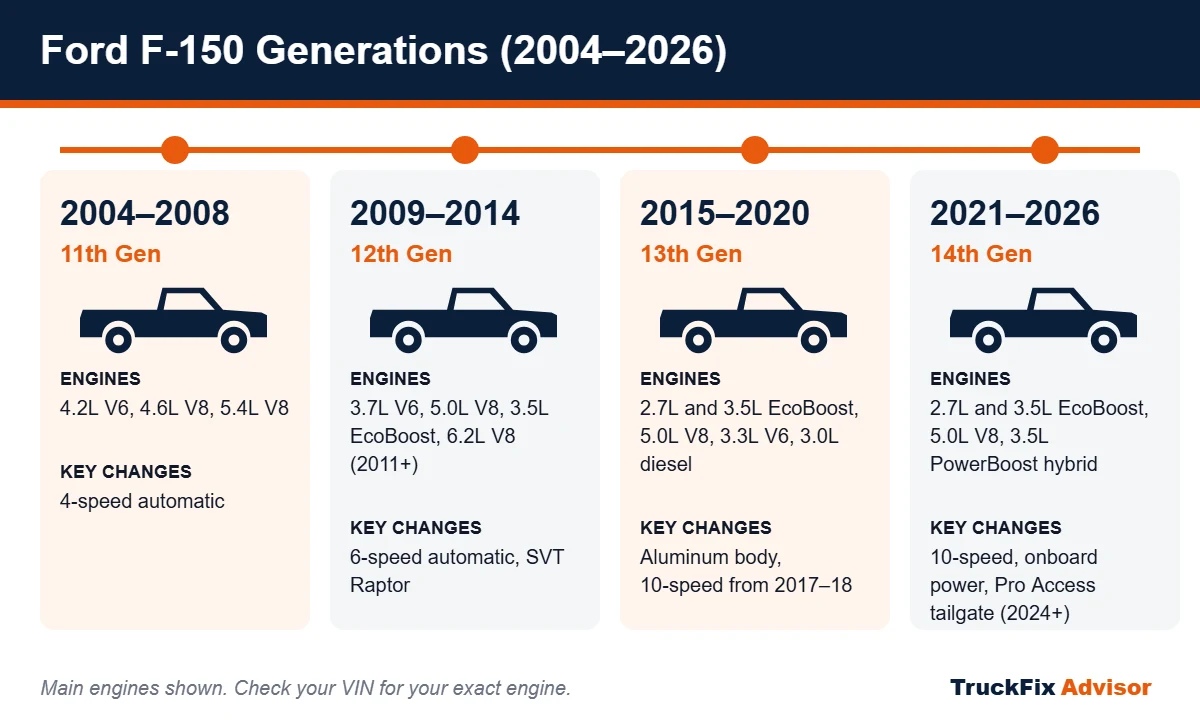
Know Your F-150: Generations and Engines
Almost every spec on this page depends on two things: your truck’s generation and its engine. Ford redesigns the F-150 every six or so years, and parts and specs often change at those breaks. Find your model year in the table below first.
| Model years | Generation | Big changes | Main engines | Transmission |
|---|---|---|---|---|
| 2004–2008 | 11th F-Series | New body and 3-valve 5.4L V8 | 4.2L V6, 4.6L V8, 5.4L V8 | 4-speed automatic (manual on some base trucks) |
| 2009–2014 | 12th F-Series | New chassis; all-new engines from 2011; SVT Raptor | 2011–14: 3.7L V6, 5.0L V8, 3.5L EcoBoost, 6.2L V8 | 6-speed automatic (6R80) |
| 2015–2020 | 13th F-Series | Aluminum body (about 700 lb lighter); 2018 refresh | 2.7L and 3.5L EcoBoost, 5.0L V8, 3.5L V6 (2015–17), 3.3L V6 (2018–20), 3.0L diesel (from 2018) | 6R80 6-speed; 10R80 10-speed on most engines from 2017–2018 |
| 2021–2026 | 14th F-Series | Full redesign; PowerBoost hybrid and onboard power; Lightning EV; 2024 refresh with Pro Access tailgate | 2.7L and 3.5L EcoBoost, 5.0L V8, 3.5L PowerBoost hybrid, 3.3L V6 (2021–23), Raptor 3.5L HO and Raptor R 5.2L | 10R80 10-speed |
The 2015 redesign is the most important break for owners. The aluminum body, new bed, new wheel studs and new electrical systems mean many 2014 parts do not fit a 2015 truck, even when they look the same.
How to Tell Which Engine Your F-150 Has
- VIN: the 8th character of the 17-digit VIN is the engine code. Enter the VIN in a free decoder to see the engine name.
- Badges: many trucks have an engine badge on the front fenders or tailgate, such as “5.0” or “EcoBoost.”
- Engine cover: EcoBoost and PowerBoost engines are labeled on the cover under the hood.
- Paperwork: the original window sticker and the registration often list the engine.
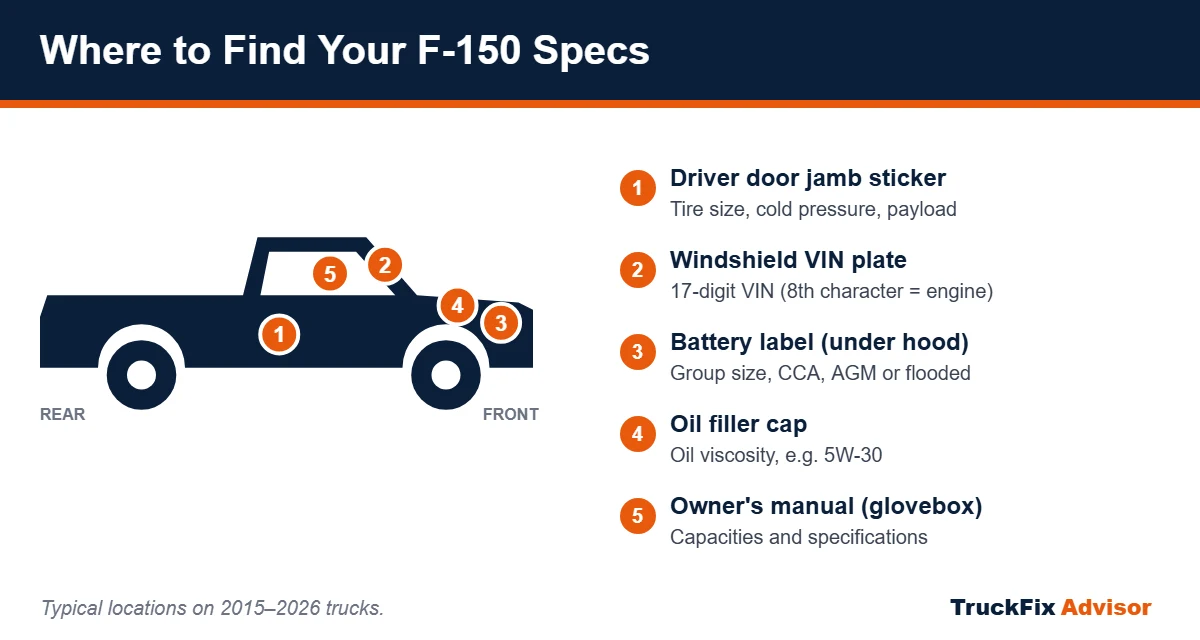
Where to Find the Specs on Your Own Truck
Your F-150 carries most of the numbers you need on labels and plates. Checking them takes a few minutes and is the best way to confirm any spec before you buy parts.
| Location | What it tells you |
|---|---|
| Driver door jamb (B-pillar sticker) | Tire size, cold tire pressure, payload and GVWR |
| Bottom of the windshield, driver side | VIN (also on the door sticker and registration) |
| Battery top or front label | Battery group size, CCA and type (AGM or flooded) |
| Oil filler cap | Recommended oil viscosity (for example 5W-30) |
| Under the hood / engine cover | Engine type and emissions label |
| Glovebox: owner’s manual | “Capacities and Specifications” chapter with fluids, bulbs and torque values |
The door jamb sticker also lists your truck’s payload, which is different for every truck because it depends on cab, bed, engine and options. Use that number, not a brochure figure, when loading the bed.
Engine Oil and Oil Changes
Most F-150 engines, including the 2.7L and 3.5L EcoBoost, 3.3L V6 and 3.5L PowerBoost hybrid, take 6.0 quarts of oil with a new filter. The 5.0L V8 takes more: 7.7 quarts on 2015–2017 trucks, 8.8 quarts on 2018–2020 trucks and about 7.75 quarts on 2021–2024 trucks. The EcoBoost engines use 5W-30, and the 3.3L V6 and older 5.0L use 5W-20.
- Full chart by engine, oil grade and Motorcraft filter: Ford F-150 Oil Capacity Chart by Engine
- After the oil change, clear the reminder: How to Reset the Oil Life on a Ford F-150
Ford’s Intelligent Oil-Life Monitor sets the interval based on how you drive. Under normal use it often lands between 7,500 and 10,000 miles, and Ford recommends changing the oil at least once a year.
Wheels, Tires and Lug Nuts
Every F-150 since 2004 uses a 6×135 bolt pattern with an 87.1 mm center bore and 150 lb-ft lug nut torque. The stud thread changed in 2015 from M14x2.0 to M14x1.5, so lug nuts from older trucks do not fit newer ones.
- Bolt pattern, thread size and torque for every generation: Ford F-150 Bolt Pattern by Year + Lug Nut Torque
- After rotating tires, retrain the sensors: How to Reset TPMS on a Ford F-150
For tire pressure, always use the placard on the driver’s door jamb. It is set for your truck’s tire size and load rating.
Battery and Electrical
2004–2014 F-150s mostly use a Group 65 battery. 2015 and newer trucks use an H6 (Group 48) or H7 (Group 94R) battery depending on trim and options, and trucks with Auto Start-Stop need an AGM battery. The 3.0L diesel uses a larger H8.
- Battery size by year, AGM vs flooded and the BMS reset: Ford F-150 Battery Size by Year
- Fob not working? Ford F-150 Key Fob Battery: Size and How to Replace It
Low battery voltage can also set off warning lights, including the orange wrench, so test the battery first when electrical problems appear.
Warning Lights and Common Problems
The orange wrench light is Ford’s powertrain malfunction indicator. It usually points to an electronic throttle, transmission or voltage problem, and the truck may go into reduced-power limp mode.
- Causes, codes and what to do: Ford F-150 Wrench Light: What It Means
- Tailgate stuck shut? Ford F-150 Tailgate Won’t Open: 5 Causes and Fixes
F-150 Warning Lights Cheat Sheet
Ford uses color to show urgency. Red lights mean stop or act now, amber/orange lights mean get it checked soon, and green or blue lights are just indicators.
| Light | What it means | How urgent |
|---|---|---|
| Orange wrench | Powertrain fault; truck may limit power (limp mode) | Get codes read soon; avoid towing |
| Check engine (solid) | Engine or emissions fault | Get it checked soon |
| Check engine (flashing) | Severe misfire that can damage the catalytic converter | Reduce speed and get it checked right away |
| Oil can (red) | Low oil pressure | Stop safely and turn the engine off |
| Thermometer (red) | Engine overheating | Stop safely and let it cool |
| Battery (red) | Charging system problem | Drive to a shop; the battery may go flat |
| Tire with “!” | Low tire pressure (or TPMS fault if flashing) | Check and inflate tires |
| Brake (red) | Parking brake on, low brake fluid or brake fault | Check right away; do not drive if brakes feel wrong |
For the wrench light in detail, see Ford F-150 Wrench Light: What It Means. For the tire light, see How to Reset TPMS on a Ford F-150.
Bed Size and Accessories
The 2015–2026 F-150 comes with a 5.5 ft (67.1 in), 6.5 ft (78.9 in) or 8 ft (97.6 in) bed, all 50.6 inches wide between the wheel wells. Bed covers, liners and mats are sold by bed length and model year, so measure before you buy.
- Exact measurements, cab and bed combos and what fits: Ford F-150 Bed Dimensions
Visibility
All 2009–2026 F-150s use 22-inch wiper blades on both sides with a J-hook arm. Most 1997–2007 trucks use 20-inch blades.
- Sizes by year and replacement steps: Ford F-150 Wiper Blade Size by Year
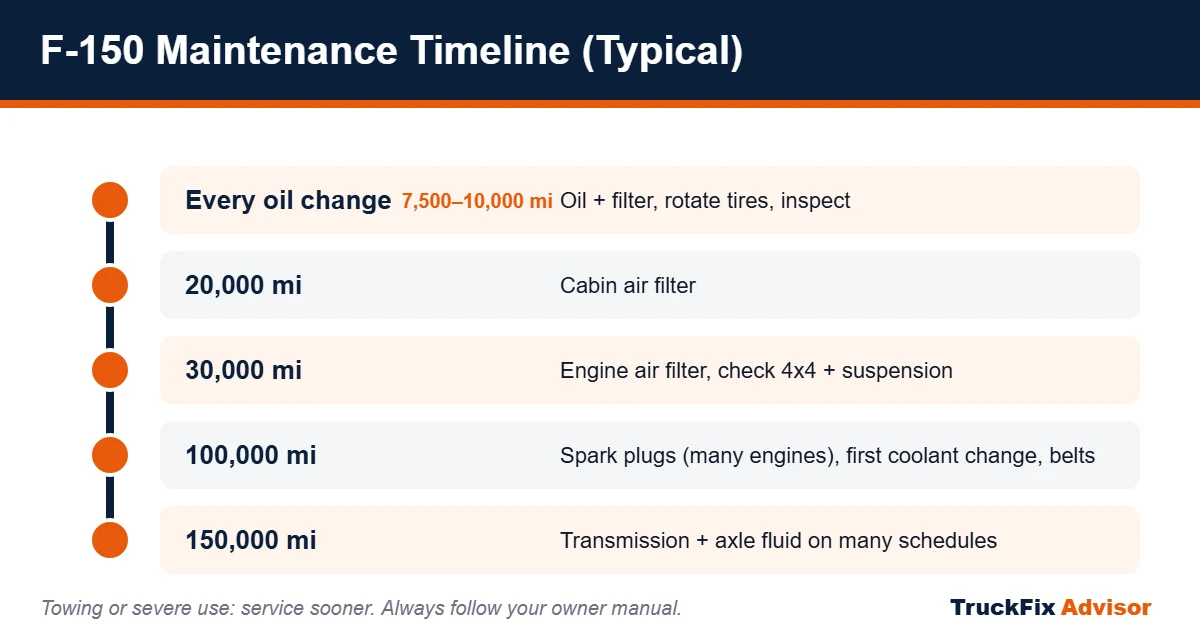
F-150 Maintenance Schedule by Mileage
Ford’s Intelligent Oil-Life Monitor decides when the oil is due, and most other services line up with oil changes. The table below shows typical intervals for 2015 and newer F-150s under normal driving. Published schedules differ slightly by year and engine, and towing, dusty roads, short trips and extreme heat or cold all call for earlier service. Always check the scheduled maintenance section of your owner’s manual for your exact truck.
| Interval | Typical service |
|---|---|
| When the oil life monitor asks (often 7,500–10,000 mi), at least yearly | Oil and filter change, reset oil life, multi-point inspection |
| Every oil change (about 7,500–10,000 mi) | Rotate tires, torque lug nuts, retrain TPMS, check brakes and fluids |
| About 20,000 mi | Replace cabin air filter (sooner if airflow drops or smells appear) |
| About 30,000 mi | Replace engine air filter (sooner in dusty conditions); inspect suspension and 4×4 components |
| About 100,000 mi | Spark plugs on many engines, first coolant change on many trucks, inspect drive belts |
| About 150,000 mi | Transmission and axle fluid service on many schedules (much sooner with heavy towing) |
If you tow often, plow, drive off-road or idle for long periods, treat your truck as “severe service.” That usually means oil changes closer to 5,000 miles and earlier fluid changes for the transmission and axles.
Quick Owner Checklist
- Every fill-up: look for warning lights and check the tires visually.
- Monthly: cold tire pressure, oil level, washer fluid and lights.
- Every fall: test the battery, replace wiper blades and lubricate the tailgate latches.
- Every 2–4 years: replace key fob batteries.
Commonly Reported F-150 Problems by Generation
Every truck line has weak spots. Knowing what owners commonly report for your generation helps you catch problems early. These are patterns widely discussed by owners and mechanics, not a guarantee that your truck will have them.
| Generation | Commonly reported issues | What to do |
|---|---|---|
| 2004–2008 | 5.4L 3-valve: spark plugs that can break during removal; cam phaser and timing chain noise (ticking or knocking at idle) | Have plugs changed by a shop that knows the 5.4L procedure; use the correct oil and keep up with oil changes |
| 2009–2014 | 3.5L EcoBoost: timing chain stretch (rattle on cold start) and occasional misfires in humid weather; electronic throttle body faults | Listen for cold-start rattle; check for Ford service updates for your VIN |
| 2015–2020 | 10-speed transmission shift quality complaints; 2.7L/3.5L EcoBoost cam phaser rattle on some engines; tailgate release electrical issues on some 2015–2018 trucks | Ask a dealer about software updates and service programs (such as 20N03 for the tailgate) |
| 2021–2026 | Recalls and software updates for electronics and cameras on some trucks; early-build issues typical of a redesign | Check open recalls by VIN and keep software up to date |
Before buying a used F-150, or when a problem appears, enter the VIN at nhtsa.gov/recalls to see open recalls. Recall repairs are free at Ford dealers.
First Upgrades Most F-150 Owners Make
If you just bought an F-150, these are the add-ons owners usually reach for first, and what to check before buying each one:
- All-weather floor liners: protect the carpet from mud and snow. Match your cab style and whether you have a front bench or console.
- Bed liner or bed mat: protects the bed floor. Spray-in liners are permanent; drop-in liners and rubber mats are cheaper and removable. Match your bed length.
- Tonneau cover: keeps cargo dry and hidden and can slightly improve highway fuel economy. Check bed length, model year and whether the truck has a bed rail system.
- Trailer hitch accessories: most F-150s have a factory receiver. Check the hitch class and your truck’s towing rating on the door sticker and owner’s manual before towing.
- A good torque wrench and tire gauge: the two tools that make the most common DIY jobs, like rotating tires, safer and more accurate.
Buying Parts for Your F-150: Match the Model Year
The F-150 has been sold for decades, so parts listings can be confusing. A few rules prevent most wrong orders:
- Use year ranges, not just “F-150.” A listing for “2015–2020 F-150” will usually not fit a 2014 or a 2021 truck.
- Check the engine. Oil filters, spark plugs, belts and many sensors are engine-specific. The 2.7L EcoBoost, for example, uses a different oil filter than the 3.5L.
- Check the bed length and cab. Bed covers, liners, mats and running boards depend on cab style and bed length.
- Check for trim features. Bed lights, the Pro Access tailgate, the factory spray-in liner and 360-degree cameras can change which accessories fit.
- Thread sizes changed in 2015. Lug nuts and wheel spacers for 2004–2014 trucks (M14x2.0) do not fit 2015+ trucks (M14x1.5).
More F-150 Guides Coming Soon
We are adding detailed, year-by-year guides for towing capacity, coolant type and capacity and transmission fluid. Each one will be linked from this page as soon as it is published.
Frequently Asked Questions
Where can I find the specs for my exact F-150?
Your owner’s manual has a “Capacities and Specifications” section. The tire placard on the driver’s door jamb lists tire sizes and pressures, and the battery label shows the group size. A VIN decoder confirms your engine, bed length and trim.
How do I know which engine my F-150 has?
Check the engine cover (EcoBoost engines are labeled), the badges on the fenders, or the 8th character of the VIN, which is the engine code. The window sticker also lists the engine.
Do 2015 and newer F-150 parts fit older trucks?
Often not. The 2015 redesign changed the body, bed and wheel studs. Wheels still share the 6×135 pattern, but lug nuts, bed covers and many trim parts are year-specific. Always buy parts listed for your model year range.
What is the best year for a used F-150?
It depends on your budget and needs, but many buyers look for trucks from the later years of a generation, after early problems were fixed. Whatever year you choose, check the service history, look up open recalls by VIN on the NHTSA website, and have a mechanic inspect the truck before buying.
What is the difference between EcoBoost and PowerBoost?
EcoBoost engines (2.7L and 3.5L) are turbocharged gas V6s. PowerBoost, offered from 2021, pairs the 3.5L EcoBoost with an electric motor and battery in a hybrid system, and it can power tools and appliances through onboard outlets.
Where is the payload rating on my F-150?
Look at the tire and loading sticker on the driver’s door jamb. It lists the maximum combined weight of passengers and cargo for your exact truck, which is the number to use when loading the bed.
How often should I service my F-150?
Follow the oil life monitor for oil changes, rotate tires about every oil change, and check the battery, wipers and tire pressure seasonally. Towing and severe use mean more frequent service.
This guide summarizes our detailed F-150 articles, which are built from Ford owner’s manual data and other published specifications. We update it as we add new guides.