
Every Ford F-150 from 2004 to today uses a 6×135 bolt pattern (6 lugs on a 135 mm circle) with an 87.1 mm center bore and a lug nut torque of 150 lb-ft. What changed in 2015 is the stud thread: older trucks use M14x2.0, newer ones use M14x1.5. The chart below covers every generation, so you can buy wheels, lug nuts and spacers that actually fit.
This guide is part of our Ford F-150 Owner’s Guide, with every key spec and common fix in one place.
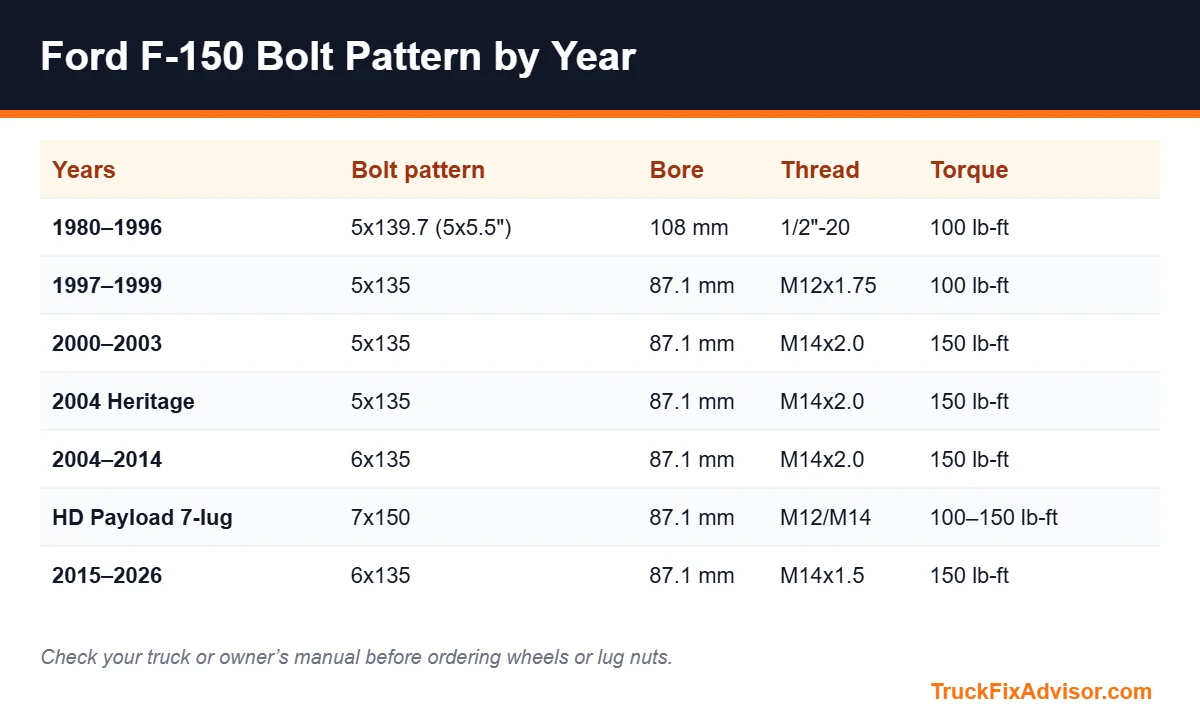
F-150 Bolt Pattern Chart by Year
| Model years | Bolt pattern | Center bore | Stud / lug thread | Lug nut torque |
|---|---|---|---|---|
| 1980–1996 | 5×139.7 mm (5×5.5″) | 108 mm (4WD hubs) | 1/2″-20 | 100 lb-ft |
| 1997–1999 | 5×135 mm (5×5.31″) | 87.1 mm | M12x1.75 | 100 lb-ft |
| 2000–2003 | 5×135 mm (5×5.31″) | 87.1 mm | M14x2.0 | 150 lb-ft |
| 2004 Heritage (old body) | 5×135 mm (5×5.31″) | 87.1 mm | M14x2.0 | 150 lb-ft |
| 2004–2014 | 6×135 mm (6×5.31″) | 87.1 mm | M14x2.0 | 150 lb-ft |
| 1997–2014 Heavy Duty Payload (7-lug) | 7×150 mm (7×5.9″) | 87.1 mm | M12x1.75 or M14x2.0 | 100–150 lb-ft |
| 2015–2026 (incl. Raptor, Lightning) | 6×135 mm (6×5.31″) | 87.1 mm | M14x1.5 | 150 lb-ft |
Ford changed from 12 mm to 14 mm studs partway through the 1999–2000 model years, so on trucks from that period, measure a stud or check the lug nut before ordering parts.
What Does 6×135 Mean?
A bolt pattern has two numbers. The first is the number of lug studs (6). The second is the diameter of the imaginary circle that runs through the center of the studs, in millimeters (135 mm, which is about 5.31 inches). A wheel only bolts on if both numbers match your truck.
The center bore is the hole in the middle of the wheel. On the F-150 it is 87.1 mm. A wheel with a bigger bore can still fit if you use hub-centric rings, but a wheel with a smaller bore will not fit at all.
F-150 Bolt Pattern by Generation
2015 to present (13th and 14th generation)
All 2015 and newer F-150s, including the Raptor, Tremor and the electric Lightning, use 6×135 mm with an 87.1 mm bore. The big change is the stud thread, which went to the finer M14x1.5. That means lug nuts from a 2014 truck will not thread onto a 2015 truck, even though the wheels bolt up the same.
2004 to 2014 (11th and 12th generation)
The 2004 redesign brought the 6×135 mm pattern that Ford still uses. These trucks use M14x2.0 studs. Wheels from these years physically fit 2015+ trucks (and the other way around), but you need lug nuts with the correct thread for each truck.
2004 F-150 Heritage
The 2004 “Heritage” model was the old 10th-generation body sold alongside the new truck. It kept the 5×135 mm pattern, so do not buy 6-lug wheels for a Heritage.
1997 to 2003 (10th generation)
These trucks use 5×135 mm. Early trucks have 12 mm studs (torqued to 100 lb-ft), and later trucks have 14 mm studs (torqued to 150 lb-ft). The 7-lug 7×150 mm pattern appeared on Heavy Duty Payload Package trucks of this era.
1980 to 1996
Older F-150s use the classic 5×5.5 inch (5×139.7 mm) pattern with 1/2″-20 studs, shared with many older Ford and Dodge trucks.
Lug Nut Torque: How to Tighten F-150 Wheels
- Thread every lug nut on by hand first so none cross-thread.
- Snug them in a star (criss-cross) pattern with the wheel still in the air.
- Lower the truck so the tire carries some weight.
- Torque each nut to 150 lb-ft in the same star pattern.
- Re-check the torque after the first 50 to 100 miles, especially on new wheels or after tire service.
Do not put oil or anti-seize on the studs unless your owner’s manual says to. Lubricated threads reach the same torque with much more clamping force, which can stretch studs.
Wheel Spacers for the F-150
Spacers push the wheels out for a wider stance or to clear big brakes. Always buy hub-centric spacers with an 87.1 mm bore and the right stud thread for your year:
- 2015–2026 trucks: dynofit 2-inch 6×135 hub-centric spacers (M14x1.5)
- 2004–2014 trucks: dynofit 2-inch 6×135 hub-centric spacers (M14x2.0)
Spacers change how the truck handles and put more load on wheel bearings. Torque the spacer to the hub first, then the wheel to the spacer, and re-check both after 100 miles.
Parts and Tools for This Job
Torque the lug nuts to 150 lb-ft with a real torque wrench, not an impact gun. The LEXIVON 1/2-inch click torque wrench (25–250 ft-lb) covers that range with room to spare. If your factory capped lug nuts are swollen and your 21 mm socket no longer fits, a set of dynofit one-piece M14x1.5 lug nuts for 2015–2026 F-150 fixes it for good.
Frequently Asked Questions
What is the bolt pattern on a Ford F-150?
The Ford F-150 has used a 6×135 mm (6×5.31 inch) bolt pattern since the 2004 redesign, and that is still the pattern on 2026 models. Trucks from 1997 to 2003 (and the 2004 Heritage) use 5×135 mm, and trucks from 1980 to 1996 use 5×139.7 mm (5×5.5 inch).
Is the F-150 bolt pattern the same as the Expedition?
Yes. The Ford Expedition and Lincoln Navigator from 2003 and newer also use 6×135 mm with an 87.1 mm center bore, so wheels can swap between them as long as the offset and size suit your truck. Make sure the lug nut thread matches your model year.
Will 2014 F-150 wheels fit a 2015 F-150?
The wheels themselves will bolt on because both use 6×135 mm and an 87.1 mm bore. The lug nuts will not, because 2004–2014 trucks use M14x2.0 studs and 2015+ trucks use M14x1.5. Use the lug nuts made for the truck the wheels are going on.
What is the lug nut torque for an F-150?
Ford specifies 150 lb-ft (about 204 Nm) for 2000 and newer F-150s, including the Raptor and the Lightning. Older trucks with 12 mm studs (1997–1999) and 1/2-inch studs (1980–1996) use about 100 lb-ft. Always confirm in your owner’s manual.
What size socket do F-150 lug nuts take?
Most F-150s with 14 mm studs use a 21 mm socket. Trucks with 12 mm studs use a 19 mm socket. Factory two-piece capped lug nuts can swell over time and stop fitting a 21 mm socket, which is why many owners switch to one-piece lug nuts.
Does the F-150 Lightning have the same bolt pattern?
Yes. The electric F-150 Lightning uses the same 6×135 mm pattern, 87.1 mm center bore and M14x1.5 studs as the gas F-150. Because it is a heavy truck, check the load rating of any aftermarket wheel before you buy it.
Related: Doing an oil change at the same time? See our F-150 oil capacity chart by engine.
More F-150 guides: How to reset TPMS after a tire rotation · F-150 bed dimensions · Complete F-150 owner’s guide
Specs are based on Ford owner’s manual data and wheel fitment guides. Production changes happen mid-year, so measure or check your manual before you order wheels or hardware.
As an Amazon Associate, we earn from qualifying purchases.