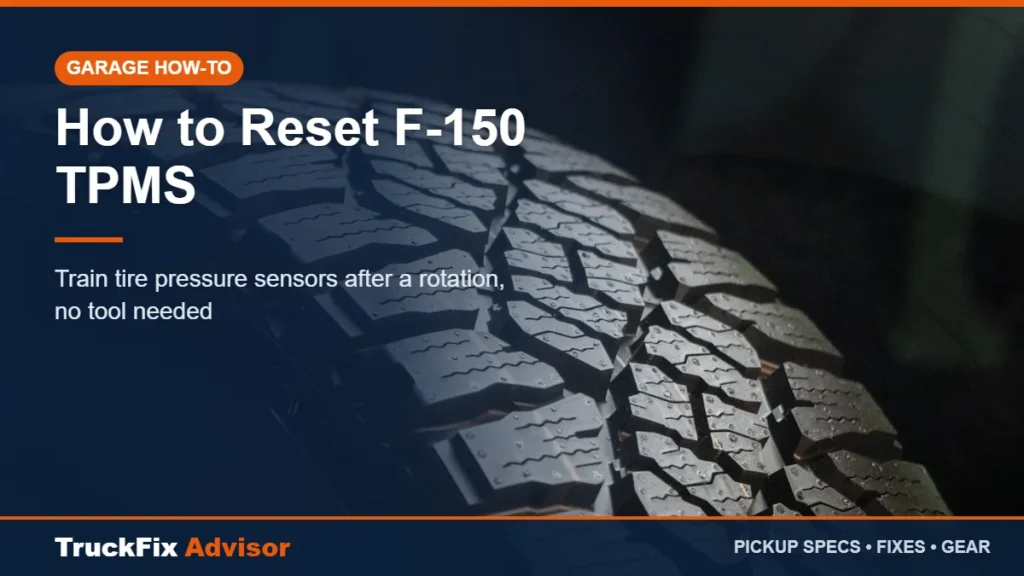

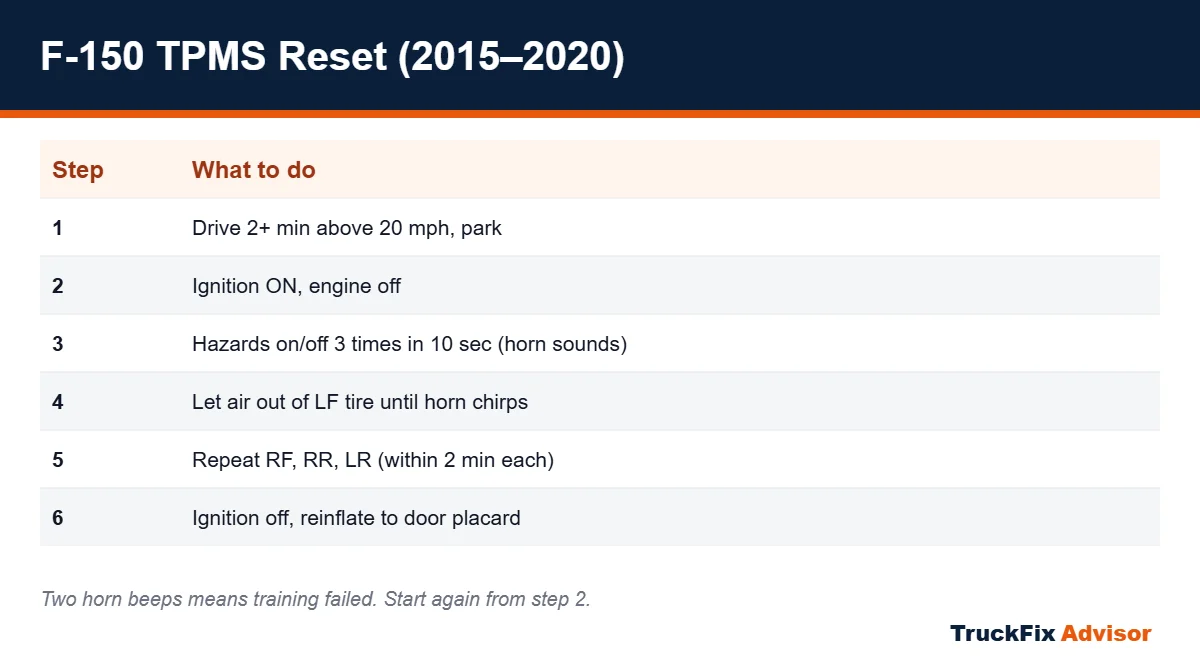
To reset the TPMS on a 2015–2020 Ford F-150, turn the ignition on (engine off), switch the hazard flashers on and off three times within 10 seconds until the horn sounds, then let air out of each tire in this order: left front, right front, right rear, left rear. The horn chirps once each time a sensor is learned. You do not need a special tool for this owner procedure. Full steps, the older-truck method and tips for the “Tire Pressure Low” warning are below.
This guide is part of our Ford F-150 Owner’s Guide, with every key spec and common fix in one place.
When Do You Need to Reset (Train) the F-150 TPMS?
| Situation | Reset needed? |
|---|---|
| Added air after a low pressure warning | No. Inflate to the door placard and drive a few minutes; the light should clear. |
| Rotated tires (truck has different front and rear pressures) | Yes. Otherwise the dash shows the right pressures at the wrong corners. |
| Rotated tires (same front and rear pressure) | Recommended, so the display shows the correct positions. |
| Installed new TPMS sensors | Yes, but new sensors often need a TPMS tool or dealer scan tool. |
| Moved the same sensors to new wheels | Train the positions with the procedure below. |
How to Reset TPMS on a 2015–2020 F-150 (No Tool)
This is the procedure from the 2015 F-150 owner’s manual. Have a tire gauge and an air compressor ready, because you will let some air out of each tire.
- Drive above 20 mph for at least 2 minutes to wake the sensors, then park where you can reach all four tires. Stay at least 3 feet away from other Ford vehicles being trained.
- Turn the ignition off, then turn it to ON with the engine off.
- Turn the hazard flashers on and off three times within 10 seconds. The horn sounds once and the TPMS light flashes. If not, turn the ignition off and start again.
- Go to the left front tire, remove the valve cap and let air out until the horn chirps once. That sensor is learned.
- Repeat on the right front, then right rear, then left rear. Do each tire within 2 minutes of the last one, or the system times out and you must start over.
- After the last tire the horn sounds and the TPMS light stops flashing. Turn the ignition off.
- Reinflate all four tires to the pressure on the door placard.
If you hear two horn beeps at any tire, or two short beeps when you turn the ignition off, the training failed. Start again from step 2.
2021 and Newer F-150
Newer trucks use the same basic idea, but the exact steps can differ by trim and whether the truck has push-button start. Some owners report the hazard-flasher method works on 2021+ trucks, and service information for the 2023 F-150 says the system does not automatically recognize sensors that have moved to a new position. Check the “Tire Pressure Monitoring System” section of your owner’s manual for your exact steps, or have the tire shop train the sensors after a rotation.
2010–2014 F-150
Trucks from this era use an ignition-cycling procedure to enter training mode, and many shops use a TPMS activation tool held next to each valve stem instead of letting air out. The typical sequence is: ignition off, press and release the brake, cycle the key from OFF to RUN three times ending in RUN, press and release the brake, turn it OFF, then cycle OFF to RUN three more times. The horn sounds once when training starts. Then each sensor is triggered in the same LF, RF, RR, LR order. Because the steps vary by year, confirm them in your owner’s manual.
What the “Tire Pressure Low” Warning Means
Each sensor reports its tire’s pressure to the truck. When a tire falls below the target pressure programmed for your truck (the value on the driver door placard), the TPMS light comes on and a low pressure message appears. Sensors report about once a minute when you are driving above 20 mph.
- Light on solid: one or more tires are low. Check all four with a gauge when the tires are cold and inflate to the door placard.
- Light flashes, then stays on: usually a system problem, such as a sensor that is not reporting, a dead sensor battery or a spare tire without a sensor.
- Light comes on on cold mornings: tire pressure drops roughly 1 psi for every 10°F drop in temperature. Add air to the cold placard pressure.
What Tire Pressure Should an F-150 Have?
Use the pressure printed on the tire placard on the driver’s door jamb, not the maximum number molded on the tire sidewall. The correct value depends on your tire size and load rating, and trucks with LT (light truck) tires often run higher pressures than trucks with P-metric tires. If you install a different tire size, ask the tire shop what pressure matches the new tires’ load rating.
Frequently Asked Questions
How do I reset the tire pressure light on my F-150?
If you just added air, drive for a few minutes above 20 mph and the light should go out by itself. If you rotated the tires, use the training procedure: ignition on, hazard lights on and off three times in 10 seconds, then let air out of each tire in LF, RF, RR, LR order until the horn chirps.
Do I need a TPMS tool to reset an F-150?
Not for the 2015–2020 owner procedure. Letting air out of each tire triggers the sensor. A TPMS tool is faster and is usually needed for new sensors or on some older trucks.
Why does my F-150 show the wrong tire pressures after a rotation?
The truck still thinks each sensor is in its old position. Run the training procedure after every rotation so the display shows the right pressure at the right corner.
Why is my TPMS light flashing?
A flashing light that then stays on usually means a fault in the system, not just low pressure. Common causes are a dead sensor battery, a damaged sensor or a wheel without a sensor. A tire shop can read the sensors with a TPMS tool.
How long do F-150 TPMS sensors last?
The sensors have built-in batteries that typically last several years. When a sensor battery dies it must be replaced, and the new sensor must be trained to the truck.
Related: See our F-150 bolt pattern and lug nut torque chart before you rotate your tires.
More F-150 guides: F-150 bolt pattern and lug nut torque · How to reset the oil life · Complete F-150 owner’s guide
TPMS procedures vary by model year, trim and ignition type. Always follow your owner’s manual, and reinflate the tires to the door placard pressure after training.